Delivery & Returns
Store locator / click & collect
Map finder + collect option
In one sentence
What it is
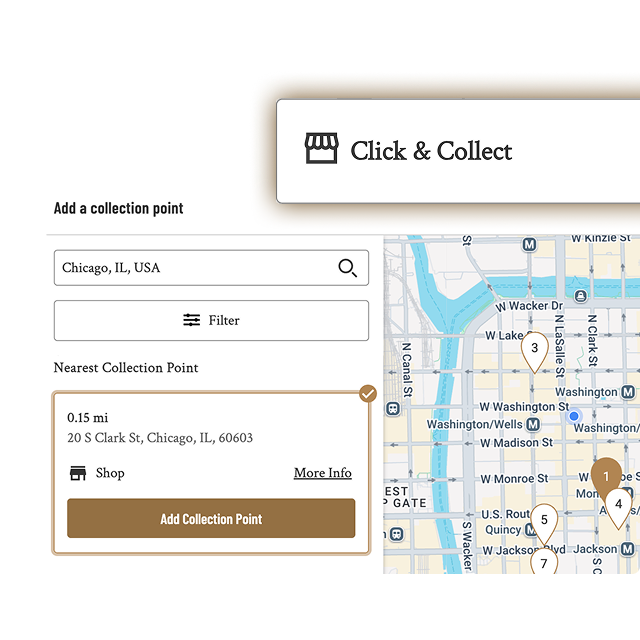
A map-based store finder combined with click & collect, so shoppers can buy online and pick up from a store — and the physical estate becomes part of the online proposition rather than a competing channel.
How it works
What it does
The store locator gives shoppers a map and searchable list of stores with the detail they need to visit — location, opening hours and contact information — configured per brand. Where click & collect is offered, collection becomes a delivery option at checkout: the shopper picks a store and collects rather than paying for and waiting in for a courier. It runs through the same basket, checkout and order flow as home delivery, so there's one order record and one customer view regardless of how the goods are handed over.
The problem it solves
Why it matters
For the brand
Retailers with stores usually run them as a separate channel from the site, which means the estate's biggest online advantages — free, fast, convenient collection and the footfall it generates — are never used. Home delivery also carries a cost and a failure rate that collection simply doesn't.
For their customers
Waiting in for a delivery, or having a parcel left somewhere insecure, is the most common complaint in ecommerce. Plenty of shoppers would rather collect on their way past, and some want to see the item before committing to keep it.
For shoppers
How it benefits shoppers
- Collect at a time that suits them instead of waiting in for a courier.
- Avoid delivery charges and the risk of a parcel left in the wrong place.
- Often faster than home delivery when the stock is already local.
- Find their nearest store, its hours and how to contact it without leaving the site.
For the brand
How it benefits the brand
Collection removes last-mile cost and delivery failures
Fulfilment cost per order, failed delivery rate
Collection visits generate in-store footfall and add-on sales
Attachment rate on collection, store revenue
Offering collection lifts checkout completion
Checkout conversion rate
The store estate becomes an online asset instead of a cost centre
Cross-channel revenue per store
One order record whichever way the goods are handed over
Data completeness, single customer view
In practice
What it looks like
- 1
A shopper checking out sees collection offered alongside home delivery.
- 2
They open the store finder, see three stores near them on a map with opening hours, and choose the one by their office.
- 3
They complete the order without paying a delivery charge.
- 4
They collect the next day on their lunch break — and buy something else while they're in the store.
Where it lands hardest
Strong use cases by industry vertical
Health, wellness & nutrition
Works where a store estate exists — collection suits bulk protein and heavy formats that are expensive to ship and awkward to receive at home.
Beauty & personal care
Strong. Collection brings shoppers into a space built for discovery and consultation, and the add-on purchase rate on collection visits is high.
Food, drink & FMCG
Natural fit for anything chilled, fragile or heavy, where a missed home delivery means loss rather than inconvenience.
Pet care
Excellent for large bags of food where shipping cost is punishing and shoppers are already making a regular trip.
Fashion & apparel
The classic use case — collect, try on, and hand back what doesn't fit in the same visit, which converts a return into an exchange.
Luxury & premium lifestyle
Reframe as a booked collection or in-boutique handover; done well it's a service moment, done casually it cheapens the purchase.
Common questions & objections
What clients usually ask
Why the platform version wins
Collection is a delivery method inside the platform's own checkout, not a separate store-fulfilment app bolted alongside it — so the order, the customer record and the loyalty accrual are identical whether the goods went to a doorstep or a shop counter.