Discovery & Personalisation
Price presentation
"From" pricing, price per unit, discount % badges, general product titles
In one sentence
What it is
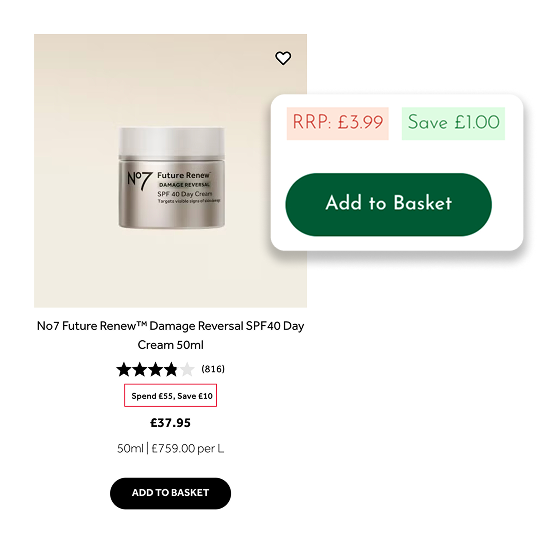
Price presentation controls how prices are shown across the site — 'from' pricing, price-per-unit, discount badges and general product titling — so shoppers can compare value at a glance and the brand can trade with more nuance than a single number.
How it works
What it does
On listings and product pages, the brand can configure how price information is displayed: a 'from' price where a product has multiple price points across variants, a price-per-unit calculation (per 100g, per wash, per serving) to support genuine value comparison, a discount percentage badge on reduced items, and general product titles that describe a product family rather than one specific variant. These are presentation toggles applied per brand rather than pricing-engine changes — the underlying price is set elsewhere; this controls how it's communicated to the shopper at the point of browsing and deciding.
The problem it solves
Why it matters
For the brand
A single flat price shown on every listing understates the complexity of variant pricing and hides genuine value signals — a bulk pack that's actually cheaper per unit looks more expensive at a glance, which works against the brand's own best offers.
For their customers
Comparing value across pack sizes or variants is hard without a consistent unit price, and a discount that isn't visually flagged is easy to miss entirely — leaving genuinely good deals unnoticed.
For shoppers
How it benefits shoppers
- Clear price-per-unit comparison across pack sizes, so the better-value option is obvious.
- Discount badges make genuine savings visible without hunting through the page.
- 'From' pricing sets accurate expectations before clicking into variant options.
- General product titles help when browsing a family of related products rather than one exact SKU.
For the brand
How it benefits the brand
Value-led presentation supports upsell to better-margin pack sizes
Attach rate on larger or bundled sizes
Discount visibility improves conversion on promoted lines
Sell-through on discounted SKUs
Accurate 'from' pricing reduces price-related complaints post-click
Price-expectation related support contacts
Consistent presentation across a large variant range without manual titling work
Merchandising time on price display
In practice
What it looks like
- 1
A product with five pack sizes shows a 'from' price on the listing reflecting its cheapest variant.
- 2
Each variant option on the product page shows its own price-per-unit so the shopper can compare directly.
- 3
A seasonal discount is applied and a percentage-off badge appears automatically on the listing.
- 4
The shopper picks the pack size with the best per-unit value, informed rather than guessing.
Where it lands hardest
Strong use cases by industry vertical
Health & nutrition
Per-serving and per-100g comparisons are exactly how value-conscious supplement shoppers evaluate pack-size options.
Beauty & personal care
Price-per-ml or per-wash comparisons help justify premium pricing against mass-market alternatives on genuine value grounds.
Food, drink & FMCG
Price-per-unit is close to a shopper expectation in this category, mirroring supermarket shelf-edge labelling.
Pet care
Bag-size value comparison is a common purchase decision, making per-unit pricing directly useful here.
Fashion & apparel
Honest note: price-per-unit has little relevance; discount badging and general titling matter more for fashion.
Luxury & premium
Discount badging should be used sparingly to avoid undercutting a premium price narrative; 'from' pricing is more broadly useful here.
Common questions & objections
What clients usually ask
Why the platform version wins
Because presentation reads live from the same catalogue pricing used at checkout, what a shopper sees on the listing is guaranteed to match what they're charged — there's no separate pricing display layer to keep in sync.