Checkout & Payments
Persistent basket
Survives sessions and devices
In one sentence
What it is
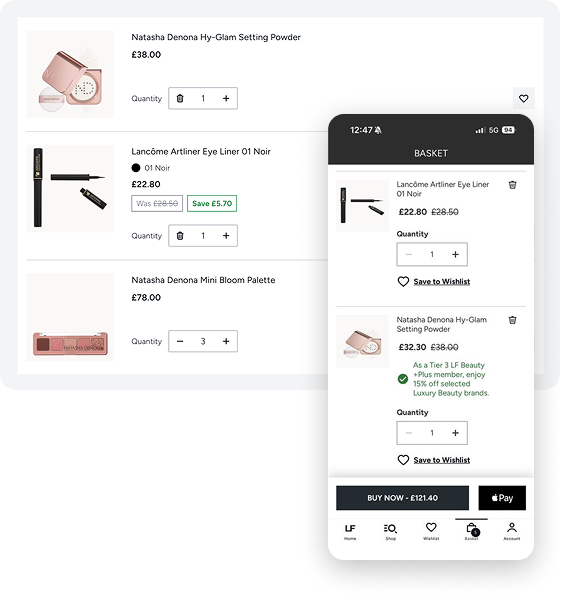
The basket follows the customer across sessions and devices, so a basket built on a phone at lunchtime is still there on a laptop that evening — and the days between browsing and buying stop costing sales.
How it works
What it does
Basket contents are held against the customer rather than the browser session. Close the tab, come back tomorrow, switch from mobile to desktop, and the basket is intact with live prices and current availability. For signed-in customers it carries across every device; for guests it survives the session and merges cleanly into the account basket when they log in, so nothing is lost or duplicated at sign-in. It's standard platform behaviour, not something that needs enabling.
The problem it solves
Why it matters
For the brand
Very few considered purchases complete in one sitting. Shoppers research on a phone and buy on a desktop, or come back after payday. When the basket empties in between, that entire decision journey is thrown away — and it looks like an abandonment problem when it's actually a memory problem.
For their customers
Rebuilding a basket is dull and easy to get wrong, especially with variants. Faced with starting again, plenty of people simply don't — or they rebuild it somewhere more convenient.
For shoppers
How it benefits shoppers
- Pick up exactly where they left off, on any device, without rebuilding anything.
- Use the basket as a shortlist while they think, without losing the work.
- Research on a phone and complete comfortably on a bigger screen.
- Nothing disappears or duplicates when they log in mid-journey.
For the brand
How it benefits the brand
Multi-session and multi-device journeys convert instead of evaporating
Conversion rate, cross-device conversion
Recovered baskets need no discount to bring back
Recovery cost, margin protected
Abandonment reflects real hesitation, not lost data
Basket abandonment rate, data quality
Makes abandoned-basket messaging land on a basket that still exists
Campaign recovery rate
Larger, more considered baskets are viable
Average order value
In practice
What it looks like
- 1
A shopper adds four items on their phone during a commute and closes the browser.
- 2
That evening they open the site on a laptop and log in.
- 3
The basket is there, complete, with current prices and any stock changes reflected.
- 4
They add one more item and check out — the journey took two devices and eight hours.
Where it lands hardest
Strong use cases by industry vertical
Health, wellness & nutrition
Regimen baskets are assembled over days, often with research between additions — losing that work is losing a large, high-margin order.
Beauty & personal care
Discovery starts on mobile via social and finishes on desktop; the basket is the bridge between the two contexts.
Food, drink & FMCG
The strongest fit. Large replenishment shops are built up over the week and completed in one go; a basket that empties nightly makes the category unworkable.
Pet care
Bulk orders combining food, treats and consumables are assembled gradually and are painful to rebuild from scratch.
Fashion & apparel
Baskets are used as a shortlist while shoppers deliberate on size and fit; persistence is what makes that deliberation possible on your site rather than a competitor's.
Luxury & premium lifestyle
High-value purchases have the longest consideration windows of all — the basket may need to survive days, and often a conversation with someone else.
Common questions & objections
What clients usually ask
Why the platform version wins
Because the basket lives on the platform rather than in the browser, it's the same basket everywhere — storefront, app surface and marketing recovery all reference one real object, rather than a cookie that a device change or a cleared cache quietly deletes.