Checkout & Payments
Payment methods
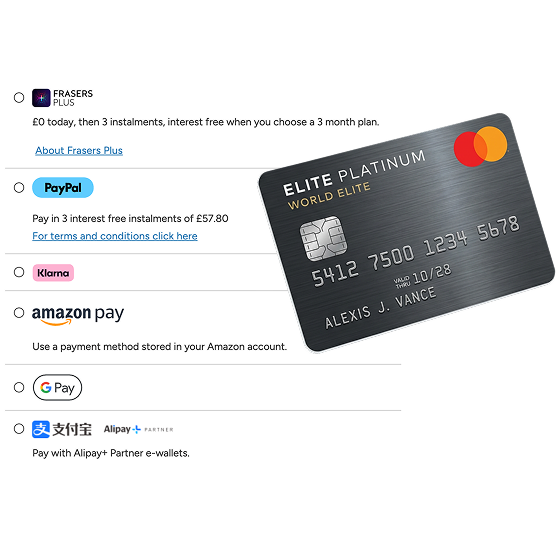
Worldpay, Adyen, PayPal, Klarna, Apple Pay, Google Pay, AfterPay/Clearpay, Alipay+, iDEAL, Bancontact, Multibanco, SEPA, UnionPay and more
In one sentence
What it is
A broad set of integrated payment methods — from Worldpay, Adyen and PayPal to Klarna, Apple Pay, Google Pay, Clearpay, Alipay+, iDEAL, Bancontact, Multibanco, SEPA and UnionPay — so shoppers in every market can pay the way they normally pay.
How it works
What it does
Payment methods are integrated at platform level and configured per market, so each storefront presents the methods that are normal and trusted where the shopper is. Wallets shortcut the whole form-filling step, buy-now-pay-later providers appear where they're licensed, and local bank-transfer schemes — iDEAL in the Netherlands, Bancontact in Belgium, Multibanco in Portugal — appear where they dominate. All of it runs through the same checkout, basket and order flow, with 3DS and strong customer authentication applied per market, and tax, duty and fraud screening handled in the same pass.
The problem it solves
Why it matters
For the brand
Payment is the last step, so every gap costs a customer who had already decided to buy. Entering a new market with only card and PayPal is the single most common way a launch underperforms — in several European markets the dominant method is a local scheme, and its absence reads as an untrustworthy site.
For their customers
People pay how they're used to paying. Being asked to type a sixteen-digit card number on a phone when they'd normally use a wallet, or finding their usual local method missing, is enough friction to abandon at the final step.
For shoppers
How it benefits shoppers
- Pay with the method they already trust, including local schemes and wallets.
- Wallet checkout in a couple of taps — no card details, no address typing.
- Spread the cost through BNPL where it's offered, without leaving the site.
- Familiar authentication that satisfies their bank rather than failing mid-payment.
For the brand
How it benefits the brand
Removes the last-step barrier for each local market
Checkout completion rate by market
Wallets materially lift mobile conversion
Mobile conversion rate
BNPL availability raises affordability of larger baskets
Average order value
New markets launch with locally credible payment from day one
Time to market, launch performance
Provider mix can be tuned commercially without re-platforming
Payment processing cost, auth rates
In practice
What it looks like
- 1
A shopper in the Netherlands reaches checkout on their phone.
- 2
iDEAL and Apple Pay appear first, because those are the methods that market actually uses.
- 3
They choose Apple Pay and authenticate with a fingerprint — no card number, no address form.
- 4
Tax and any duty are already calculated in the total, so the amount confirmed is the amount charged.
Where it lands hardest
Strong use cases by industry vertical
Health, wellness & nutrition
Repeat, moderate-value orders where stored credentials and wallets matter most — friction at payment is felt on every cycle, not once.
Beauty & personal care
Heavily mobile and heavily impulse-driven; wallet payment is often the difference between a completed basket and a lost one.
Food, drink & FMCG
Frequent low-value transactions make speed the priority — one-tap wallet payment is the whole ask here.
Pet care
Bulk food orders reach values where BNPL and instalments genuinely influence basket size.
Fashion & apparel
The strongest BNPL category by some distance — try-before-you-buy behaviour and instalments are baked into how the category shops.
Luxury & premium lifestyle
High ticket values raise the stakes on authentication and fraud. Note that BNPL branding can conflict with a luxury positioning — enable selectively.
Common questions & objections
What clients usually ask
Why the platform version wins
These are platform-level integrations sharing one basket, one order record and one fraud and tax pass — not a stack of independent payment plugins each with its own reconciliation quirks and its own way of breaking the mobile checkout.