Discovery & Personalisation
Instant search / autocomplete
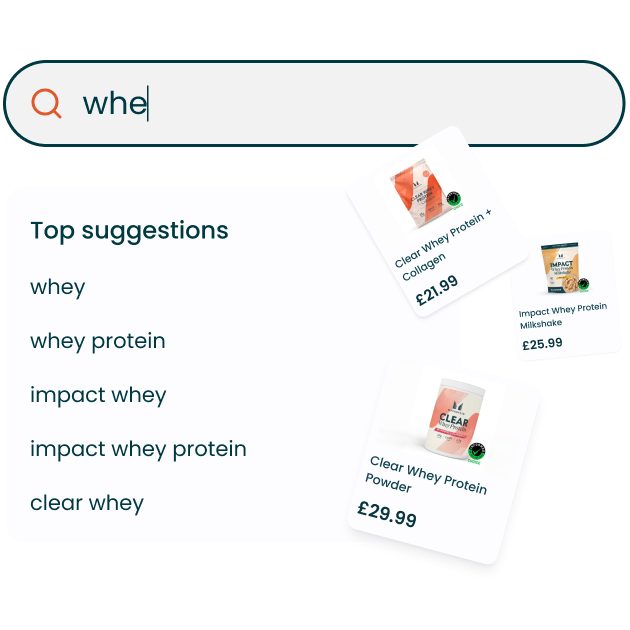
Search-as-you-type with product previews
In one sentence
What it is
Search-as-you-type that returns products, categories and suggestions with imagery and price the moment a shopper starts typing — so the fastest route to a product is a few characters.
How it works
What it does
As the shopper types, the search panel returns live results: product previews with image, name and price, plus suggested search terms and matching categories or brands. Results update on each keystroke, handle misspellings and partial words, and can be reached and navigated with a keyboard as well as a thumb. Because it runs against the central catalogue, results reflect live availability and pricing, and the terms shoppers type — including the ones that return nothing — become reportable signal about demand the range isn't meeting.
The problem it solves
Why it matters
For the brand
Shoppers who use search convert at a materially higher rate than shoppers who browse: they've told you exactly what they want. A slow search, or one that requires a full page load to reveal it found nothing, wastes the highest-intent traffic on the site.
For their customers
They know what they want and don't want to learn a category tree to get it. Typing a half-remembered product name and getting nothing back reads as 'you don't stock it', even when you do.
For shoppers
How it benefits shoppers
- Reach a product in a few characters instead of several page loads.
- See image and price before clicking, so it's obvious which result is the right one.
- Forgiving of typos and partial names — no need to know the exact product title.
- Suggested terms and categories point the way when they don't know what the thing is called.
For the brand
How it benefits the brand
Converts the highest-intent traffic on the site faster
Search-led conversion rate
Fewer abandoned sessions from failed searches
Null-result rate, exit rate from search
Search terms reveal unmet demand and range gaps
Top null-result terms, buying insight
Reduces dependence on perfect navigation structure
Path-to-product length
Surfaces the long tail that never appears in menus
Long-tail SKU visibility
In practice
What it looks like
- 1
A shopper taps the search bar and types four letters of a brand name.
- 2
The panel immediately shows five matching products with images and prices, plus two suggested categories.
- 3
A typo in the fifth letter doesn't break it — the results hold steady.
- 4
They tap a product preview and go straight to the product page, having never loaded a results page.
Where it lands hardest
Strong use cases by industry vertical
Health, wellness & nutrition
Shoppers search by ingredient, goal and brand interchangeably; instant results with imagery resolve which format and size they actually mean.
Beauty & personal care
Product names are long and easily mistyped, and shade variants look alike — visual previews in the dropdown do the disambiguation.
Food, drink & FMCG
The strongest fit for replenishment. Repeat shoppers search for known items by name and expect to be back in the basket in seconds.
Pet care
Owners search a specific food by brand and size; the wrong size is a real error, so seeing the pack shot before clicking matters.
Fashion & apparel
More browse-led than search-led, so this is supporting rather than primary — but essential for shoppers arriving with a specific item in mind from social.
Luxury & premium lifestyle
Lower volume, higher precision. Shoppers often arrive knowing the exact piece; search must find it immediately and present it with the right imagery.
Common questions & objections
What clients usually ask
Why the platform version wins
Search here is a standard part of the platform reading the same live catalogue as everything else — not a separately licensed service maintaining its own index that drifts out of sync with price and stock.