Experience & Engagement
High-resolution widget imagery
2× images for banners and cards — premium visual feel
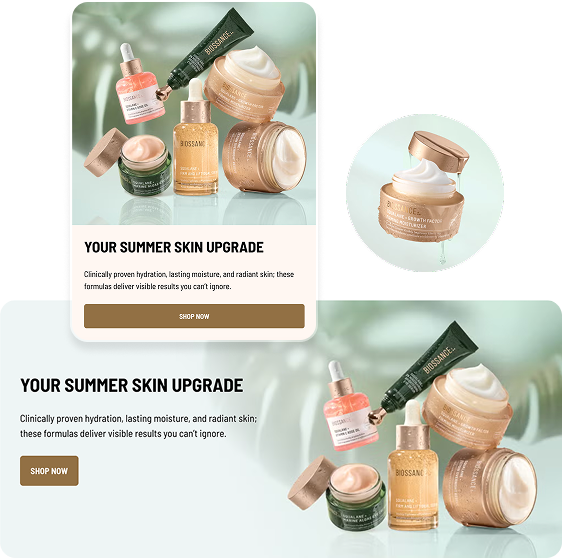
In one sentence
What it is
Support for 2× (high-density) images across banners and content cards, so a brand's photography looks crisp on the high-resolution screens most shoppers now browse on, rather than soft or upscaled.
How it works
What it does
When enabled for a brand, content widgets can serve higher-resolution image assets for the same banner and card layouts, matched to the pixel density of the shopper's screen. The brand's content team uploads the higher-resolution source images through the same page builder as before; the platform handles serving the appropriate resolution to each device rather than the brand having to manage multiple manual image exports. This is a toggle rather than a structural change, it doesn't alter layouts or require different widgets, it changes the sharpness of the imagery those widgets display.
The problem it solves
Why it matters
For the brand
Photography is one of the largest single investments a brand makes in its site, and on modern high-density phone and laptop screens, standard-resolution images can render visibly soft, quietly undermining the perceived quality of a premium product. Without a way to serve higher-density assets, the brand's actual photography budget doesn't translate into what the shopper sees.
For their customers
Shoppers use image quality as a proxy for product quality and brand credibility, often without consciously noticing why a page feels 'cheap' or 'premium'. A slightly blurred hero banner on a sharp phone screen reads as low-effort, even when the underlying photography was expensive and well-produced.
For shoppers
How it benefits shoppers
- Product and campaign imagery looks as crisp and premium on their phone or laptop as it was intended to when it was shot.
- A more trustworthy, professional first impression on campaign and category pages.
- No difference in load experience. Sharper images are served without the shopper needing to do anything or wait longer.
- Confidence that fine detail in the photography (texture, finish, colour) is actually visible rather than lost to compression.
For the brand
How it benefits the brand
Photography investment renders at full quality on modern screens
Perceived visual quality / brand consistency
No manual multi-resolution export workflow needed
Content team production time
Sharper imagery supports premium positioning without new photography spend
Return on existing creative spend
Consistent visual quality across every banner and card widget
Cross-page visual consistency
In practice
What it looks like
- 1
The product team enables high-resolution imagery for the brand as a toggle.
- 2
A merchandiser uploads a hero banner image through the page builder exactly as before, using a higher-resolution source file.
- 3
The platform automatically serves the appropriate resolution based on each shopper's screen density.
- 4
A shopper viewing the page on a high-density phone screen sees a noticeably sharper banner than they would have under the standard setting, with no change to how the page loads or behaves.
Where it lands hardest
Strong use cases by industry vertical
Health & nutrition
Useful where packaging detail and ingredient callouts need to be legible in imagery, though the fit is more functional than aesthetic compared with visually led categories.
Beauty & personal care
Texture, finish and shade accuracy are core purchase decision factors, and softness in imagery directly undermines confidence in a product's quality.
Food, drink & FMCG
Helpful for premium and gifting ranges where presentation matters, though the uplift is less critical for everyday, function-first FMCG products.
Pet care
Valuable for premium pet and lifestyle brand imagery.
Fashion & apparel
Fabric texture, drape and finish are exactly the kind of detail that suffers most from soft, low-density imagery.
Luxury & premium
Luxury shoppers are highly attuned to production quality, and anything less than crisp, high-fidelity imagery undercuts the positioning immediately.
Common questions & objections
What clients usually ask
Why the platform version wins
Rather than the brand managing multiple manual image exports and hoping the CMS serves the right one, the platform handles density matching automatically. Meaning investment in better photography converts directly into a sharper storefront with no extra production workflow.