Experience & Engagement
Footer configuration
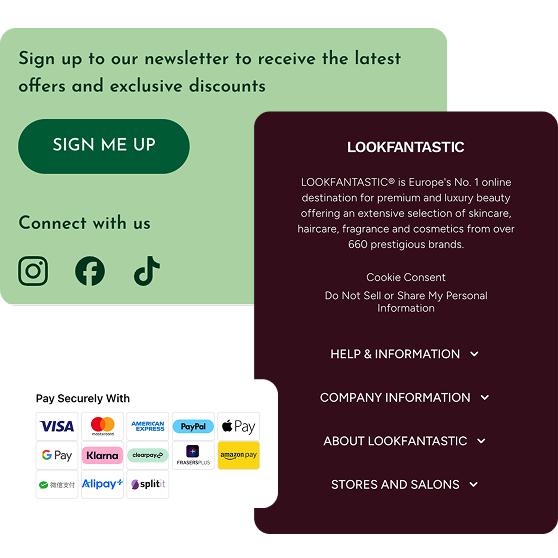
Payment icons, social icons, brand logo, accreditations, notes
In one sentence
What it is
Control over the footer's payment icons, social icons, brand logo, accreditations and free-text notes. The quiet, trust-building real estate at the bottom of every single page.
How it works
What it does
The footer is configured per brand to display the specific set of trust and identity signals relevant to that business: which payment methods are accepted, links to the brand's social channels, the brand's logo treatment, any accreditations or certifications (security seals, industry bodies, sustainability marks), and free-text notes for anything else that needs stating, such as company registration details or a short brand statement. Some elements (which icons and logos appear) are toggled on or off; others (the actual accreditation badges, notes text, social links) are configured with the specific values the brand supplies. Because the footer appears identically on every page, a single configuration change updates trust signals sitewide at once.
The problem it solves
Why it matters
For the brand
The footer is unglamorous but carries real weight. It's the one part of the page a cautious shopper checks specifically to reassure themselves before paying, and every brand has a slightly different set of things it needs to say there: different payment providers, different accreditations, different regulatory notes by market. A fixed, unconfigurable footer either shows irrelevant information or misses the specific trust signal that matters for that brand's audience.
For their customers
Before entering payment details on an unfamiliar site, many shoppers scroll to the footer looking for reassurance recognisable payment logos, security marks, a real company registration. Its absence, or a footer that looks generic and unmaintained, is a quiet but real reason for cart abandonment.
For shoppers
How it benefits shoppers
- Recognisable payment method logos provide reassurance before entering card details.
- Accreditation and security marks give a concrete reason to trust an unfamiliar or newer brand.
- Easy access to the brand's social channels for shoppers who want to check recent activity or reviews before buying.
- Clear company and regulatory information for shoppers who want to verify who they're buying from.
For the brand
How it benefits the brand
Trust signals appear consistently on every page of the site
Sitewide trust consistency
Reduces checkout abandonment linked to unfamiliarity or distrust
Checkout abandonment rate
One configuration change updates footer content across the entire site
Time to update sitewide trust content
Supports market-specific regulatory or accreditation requirements
Compliance coverage by market
In practice
What it looks like
- 1
A brand adds a new sustainability accreditation it has recently achieved and wants it reflected sitewide.
- 2
The brand supplies the badge and accompanying note text to the product team, along with where it should sit relative to other footer elements.
- 3
The configured change is applied to the footer.
- 4
Every page on the site, from the homepage to a deep product page, now shows the new accreditation without any page-by-page updates.
Where it lands hardest
Strong use cases by industry vertical
Health & nutrition
Accreditations (informed-sport, quality certifications) are often a genuine purchase driver in this category, making footer configuration for badges particularly valuable.
Beauty & personal care
Cruelty-free and sustainability accreditations are increasingly decision-relevant, and the footer is a standard, expected place for shoppers to look for them.
Food, drink & FMCG
Regulatory notes and certifications (organic, fair trade) are often required or expected, making configured footer content genuinely functional rather than decorative.
Pet care
Useful for veterinary or nutritionist endorsements and relevant industry accreditations that build category-specific trust.
Fashion & apparel
Payment method and social proof matter most here; formal accreditations are less central than in regulated categories, though sustainability marks are increasingly common.
Luxury & premium
An oversized set of badges and icons can look busy and undercut a premium feel, so a curated, minimal configuration usually works best.
Common questions & objections
What clients usually ask
Why the platform version wins
Because footer content is configured centrally and applies sitewide from a single change, a brand's trust signals stay consistent and current everywhere at once, rather than depending on someone remembering to update every page template individually.