Discovery & Personalisation
Fast product reads
Sub-50ms typical, right-sized payloads
In one sentence
What it is
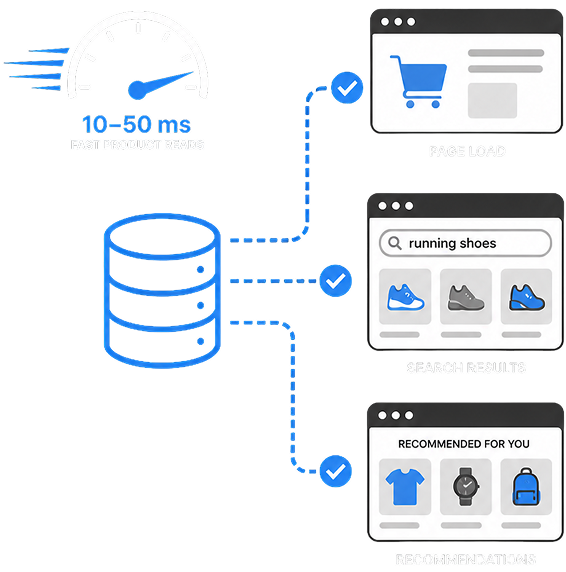
Fast product reads mean every product-data lookup — page load, search result, recommendation — returns in tens of milliseconds, so the platform can carry large catalogues and high traffic without the site feeling sluggish.
How it works
What it does
The catalogue is architected so that reading product data — price, stock, attributes, images — is typically sub-50ms, with payloads sized to what the requesting page or component actually needs rather than returning the full product record every time. This underpins every catalogue-dependent feature: product pages, listings, search, recommendations and basket all load quickly because the underlying data layer is fast by design, not because each feature has been separately optimised. It's a platform-standard characteristic rather than something a brand configures — it applies automatically as catalogue size and traffic grow, including on peak trading days.
The problem it solves
Why it matters
For the brand
As a catalogue and its traffic grow, a data layer that isn't built for speed shows it first on the busiest days — exactly when slow pages cost the most revenue, and exactly when engineering has the least room to firefight.
For their customers
A slow-loading product page or a search result that takes a visible beat to appear reads as a broken or cheap site, and shoppers on mobile networks abandon slow pages before they've even seen the product.
For shoppers
How it benefits shoppers
- Product pages, listings and search results that appear near-instantly, even on a large catalogue.
- A consistent experience on busy sale days rather than a site that visibly slows under load.
- Faster path from browsing to basket because nothing is waiting on a slow data lookup.
- A smoother mobile experience, where slow loads are felt most.
For the brand
How it benefits the brand
Site performance holds up under peak traffic without extra engineering effort
Page load time at peak, bounce rate on high-traffic days
Large catalogues don't degrade performance as they grow
Read latency as SKU count scales
Every catalogue-dependent feature inherits the speed benefit automatically
Time-to-first-byte across product, search and recommendation surfaces
Fewer performance-related engineering escalations
Performance incident volume
In practice
What it looks like
- 1
A shopper opens a product listing page on a catalogue of hundreds of thousands of SKUs.
- 2
The page requests only the fields it needs — price, image, name, stock status — rather than the full product record.
- 3
The response returns in under 50 milliseconds under normal load, and holds up similarly during a traffic spike.
- 4
The same fast-read layer serves the product page, search results and recommendations without separate optimisation work for each.
Where it lands hardest
Strong use cases by industry vertical
Health & nutrition
Subscription-heavy traffic and frequent repeat visits mean consistent speed protects a purchase pattern the brand relies on.
Beauty & personal care
Large variant catalogues with heavy imagery benefit directly from right-sized payloads keeping pages fast despite visual weight.
Food, drink & FMCG
High-frequency, low-consideration purchases are the most sensitive to load-time friction, making speed a direct conversion lever.
Pet care
A strong fit generally — nothing pet-specific about the need for speed, but replenishment shoppers are impatient by habit.
Fashion & apparel
Large seasonal catalogues and high-traffic sale events make sustained read performance particularly visible at peak.
Luxury & premium
Smaller catalogues reduce the scale pressure somewhat, but shoppers on premium sites have equally low tolerance for a sluggish page.
Common questions & objections
What clients usually ask
Why the platform version wins
Speed here isn't a premium tier or a tuning exercise applied after launch — it's a foundational property of the catalogue architecture that every brand inherits at the same standard.