Discovery & Personalisation
Central catalogue
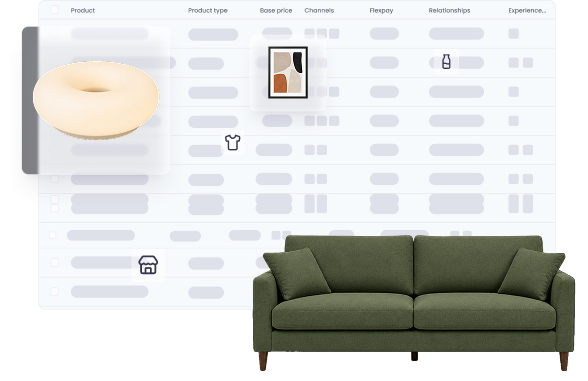
Single source for SKUs, variants, bundles, relationships
In one sentence
What it is
The central catalogue is the single system of record for every SKU, variant, bundle and product relationship — the one place every channel reads from, so nothing is ever out of step with anything else.
How it works
What it does
Every product the brand sells lives in the central catalogue as a structured record: base SKU, variants (size, colour, flavour), bundles and kits, and the relationships between them (this variant belongs to this parent, this bundle contains these SKUs). Storefront, search, recommendations, basket, checkout, marketplace feeds and reporting all read from the same catalogue rather than their own copies, so a product exists once and is described once. The brand controls what's in the catalogue — new products, discontinued lines, bundle composition, variant structure — either directly or through the PIM integration and enrichment layer that feed it. Because everything downstream reads live from one place, there's no reconciliation step between what the storefront shows and what's actually sellable.
The problem it solves
Why it matters
For the brand
Without one shared catalogue, teams end up maintaining product data separately for the storefront, the marketplace feed and internal reporting — three versions of the truth that drift apart the moment someone updates one and not the others, causing mis-priced listings and phantom stock.
For their customers
A product that shows in stock on one page and out of stock on another, or a bundle that doesn't match what actually arrives, reads as a broken, untrustworthy site — even when the underlying mistake was a data sync issue nobody meant to happen.
For shoppers
How it benefits shoppers
- Consistent stock, price and description wherever the product appears on the site.
- Bundles and variants that behave correctly — the right combination is always what's offered.
- Fewer 'sorry, that's no longer available' moments after they've already added something to basket.
- A product page that matches what turns up on a marketplace listing for the same brand.
For the brand
How it benefits the brand
One system of record eliminates cross-channel drift
Data discrepancies between storefront and marketplace
New products and bundles go live once, everywhere
Time to publish a new SKU or bundle
Reporting and trading decisions use the same numbers as the storefront
Reporting accuracy, reconciliation time
Variant and bundle logic is enforced centrally, not per team
Configuration errors, mispriced bundles
Downstream features (search, recs, feeds) inherit catalogue quality for free
Feature build cost, time to launch new channels
In practice
What it looks like
- 1
A merchandiser discontinues a variant and updates the parent-child relationship in the catalogue.
- 2
The change propagates to the storefront, the marketplace feed and internal reporting in the same pass.
- 3
A new bundle is created linking three existing SKUs with its own price and availability rules.
- 4
The bundle appears correctly on the product page and basket without any manual cross-checking against the individual SKUs.
Where it lands hardest
Strong use cases by industry vertical
Health & nutrition
Bundles (stacks, starter kits) and pack-size variants are core to how the category sells; a single catalogue keeps them consistent as formulations change.
Beauty & personal care
High variant counts across shade and size make a shared catalogue essential — without it, shade ranges fragment across channels.
Food, drink & FMCG
Multipacks and case sizes are effectively bundles; getting the parent-child relationship right avoids selling the wrong unit size.
Pet care
Bag-size and flavour variants under one parent product benefit directly from clean variant relationships.
Fashion & apparel
Size and colour variants at volume, with frequent range turnover, make catalogue discipline the difference between a clean and a chaotic PLP.
Luxury & premium
Lower SKU counts, but each bundle or gift set needs to be exactly right — the catalogue is where that composition is defined and protected.
Common questions & objections
What clients usually ask
Why the platform version wins
This isn't a cache that periodically syncs with the 'real' system — it is the real system every channel reads from, which is why cross-channel drift stops being a category of bug rather than a recurring one.