Delivery & Returns
Carrier / delivery selection
Choose delivery method at checkout
In one sentence
What it is
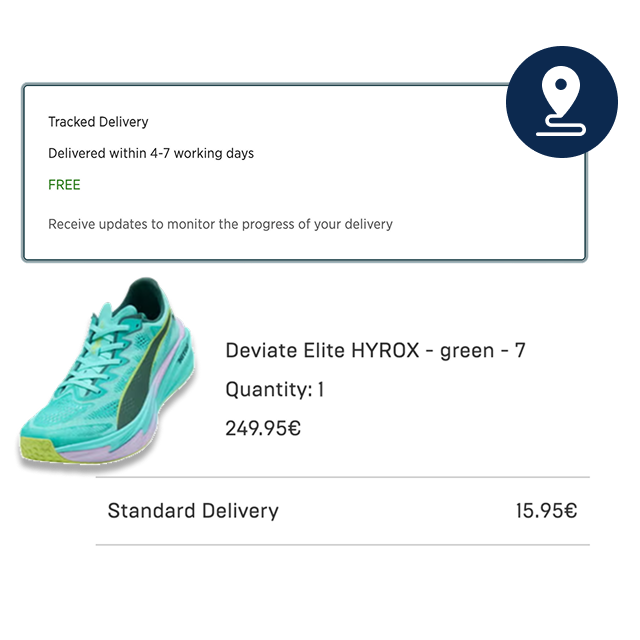
Letting the shopper choose their delivery method at checkout — standard, express, or a named carrier option — so the price and speed trade-off is their decision, not a one-size-fits-all default.
How it works
What it does
At checkout, the shopper is presented with the delivery options that apply to their basket, market and stock position — for example standard, next-day, or a specific carrier service — each with its price and expected timing shown. The brand configures which options exist, their pricing and eligibility rules (a heavy item might exclude next-day, a low-value basket might only offer standard), and the platform calculates in real time which options are genuinely available for that order rather than showing choices that can't actually be fulfilled. Selecting a method flows straight into the same order record used everywhere else, so warehouse and carrier instructions are generated automatically from the choice made.
The problem it solves
Why it matters
For the brand
Offering only one delivery speed means either overpaying to give everyone fast delivery, or losing the shoppers who'd happily pay more for speed when it matters. Getting eligibility rules wrong the other way — offering a speed the operation can't actually meet — creates missed-promise failures downstream.
For their customers
Different orders carry different urgency: a birthday gift needed by Saturday is not the same purchase as a routine restock. Being forced into one delivery speed and price, regardless of how urgent the order actually is, feels like a missed choice shoppers would pay to have.
For shoppers
How it benefits shoppers
- Choose to pay more for speed only when it actually matters for that order.
- See real delivery options for their specific basket, not a generic list that might not apply.
- Save money on routine orders by picking the standard option when there's no urgency.
- Clear price and timing shown for each option, so the decision is made with full information.
For the brand
How it benefits the brand
Captures shoppers willing to pay a premium for speed without penalising everyone else
Delivery revenue, average order value
Eligibility rules prevent promising a service the operation can't deliver
Failed delivery promise rate
One configuration drives checkout options, warehouse instructions and carrier handoff
Operational consistency, fulfilment errors
Segments delivery cost against actual shopper willingness to pay
Delivery cost recovery
In practice
What it looks like
- 1
A shopper reaches checkout with a gift that needs to arrive by the weekend.
- 2
They see standard delivery at no extra cost, and next-day at a small premium, both with expected arrival dates shown.
- 3
They pick next-day, confident it'll arrive in time rather than guessing.
- 4
The order routes to the warehouse and carrier automatically flagged for that service level.
Where it lands hardest
Strong use cases by industry vertical
Health & nutrition
Useful when a shopper has run out of a daily supplement and needs it urgently, alongside standard delivery for routine restocking.
Beauty & personal care
Strong fit for event-driven purchases — a wedding or occasion often justifies paying for guaranteed faster delivery.
Food, drink & FMCG
Particularly relevant for gifting and perishables, where carrier choice can also relate to handling requirements, not just speed.
Pet care
Matters for urgent restocking situations, though bulk and weight can limit which express options are genuinely viable.
Fashion & apparel
Strong fit for occasion-driven purchases where a specific arrival date is the whole point of the order.
Luxury & premium
Present premium delivery as a service tier rather than a paid add-on; many luxury shoppers expect a named, tracked courier as standard.
Common questions & objections
What clients usually ask
Why the platform version wins
Delivery method selection sits inside the same checkout and order flow as everything else, so the choice a shopper makes becomes a single instruction to the warehouse and carrier — rather than a separate booking system that has to be reconciled with the order afterwards.