Checkout & Payments
Build-your-own-bundle
Category-based bundle builder with limits/thresholds
In one sentence
What it is
Build-your-own-bundle is a category-based bundle builder that lets a shopper pick a set of products against a rule — say, any five items from a range for a set price — with the discount applying automatically once the threshold is met.
How it works
What it does
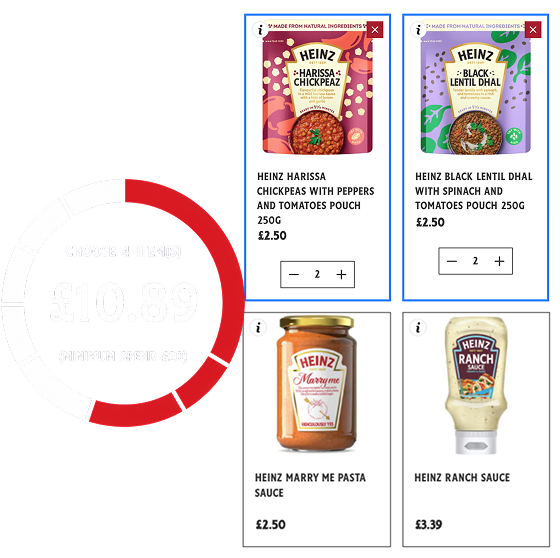
A merchandised widget presents a defined category or curated set of eligible products, along with the bundle rule: a fixed number of items for a set price, or a percentage off once a quantity threshold is reached. The shopper picks their own combination from the eligible range, sees progress toward the bundle threshold as they add items, and the discount applies automatically in the basket once the rule is met. The brand sets the eligible product range, the bundle size and the price or discount mechanic through the content and widget tooling, so it can be built, scheduled and swapped out for a new range without a development request.
The problem it solves
Why it matters
For the brand
Fixed pre-built bundles only sell to the shopper who wants exactly that combination; most shoppers want to choose their own mix. Building and re-merchandising bundles by hand for every campaign, or asking engineering to build a bespoke bundle page each time, is slow and doesn't scale across a changing product range.
For their customers
A pre-built bundle often includes one or two items the shopper doesn't want, which makes the saving feel conditional rather than real. Being forced to buy a fixed set to get a good price, when only some of it is wanted, pushes some shoppers to buy less rather than accept the waste.
For shoppers
How it benefits shoppers
- Choose their own combination of products rather than accepting a fixed set with unwanted items.
- See clearly how many more items unlock the saving as they build the bundle.
- Get a genuine discount on products they actually wanted, not a discount tied to padding.
- Discover adjacent products in the eligible range while building their bundle.
For the brand
How it benefits the brand
Increases average order value by design, not by accident
Average order value, units per basket
Merchandising range and mechanic are configured without a development request
Time to launch a bundle campaign
Surfaces the full eligible range, driving discovery within a category
Category page engagement, cross-sell rate
Bundle discount is self-funding through incremental units, protecting margin versus flat discounting
Gross margin, discount depth
In practice
What it looks like
- 1
A shopper opens a 'mix any 5 for £20' bundle widget for a skincare range.
- 2
They add three products and see a progress indicator showing two more are needed for the price to apply.
- 3
They add two more, the bundle price triggers automatically, and the saving shows in the basket.
- 4
They check out with a bundle they actually wanted, at the advertised price.
Where it lands hardest
Strong use cases by industry vertical
Health & nutrition
A strong fit for building a personal supplement stack or flavour variety across a protein range.
Beauty & personal care
One of the category's best-performing mechanics — building a personalised skincare or haircare routine at a bundle price.
Food, drink & FMCG
Suits mix-and-match multipacks (snacks, drinks flavours) closely and mirrors familiar in-store 'pick any 5' merchandising.
Pet care
Works well for treat and toy ranges bought in variety; less natural for staple food, which is usually bought in a single known product.
Fashion & apparel
Suits basics ranges (multipack socks, underwear, t-shirts) well; weaker fit for considered, single-item fashion purchases.
Luxury & premium
Honest note: weak fit generally — bundling can undercut a premium positioning unless framed carefully as a curated discovery set rather than a discount mechanic.
Common questions & objections
What clients usually ask
Why the platform version wins
Because the bundle rule runs through the same offers engine as every other discount mechanic, the saving resolves against real basket contents in real time — not a separate bundle-page calculator that has to be reconciled with the basket at checkout.